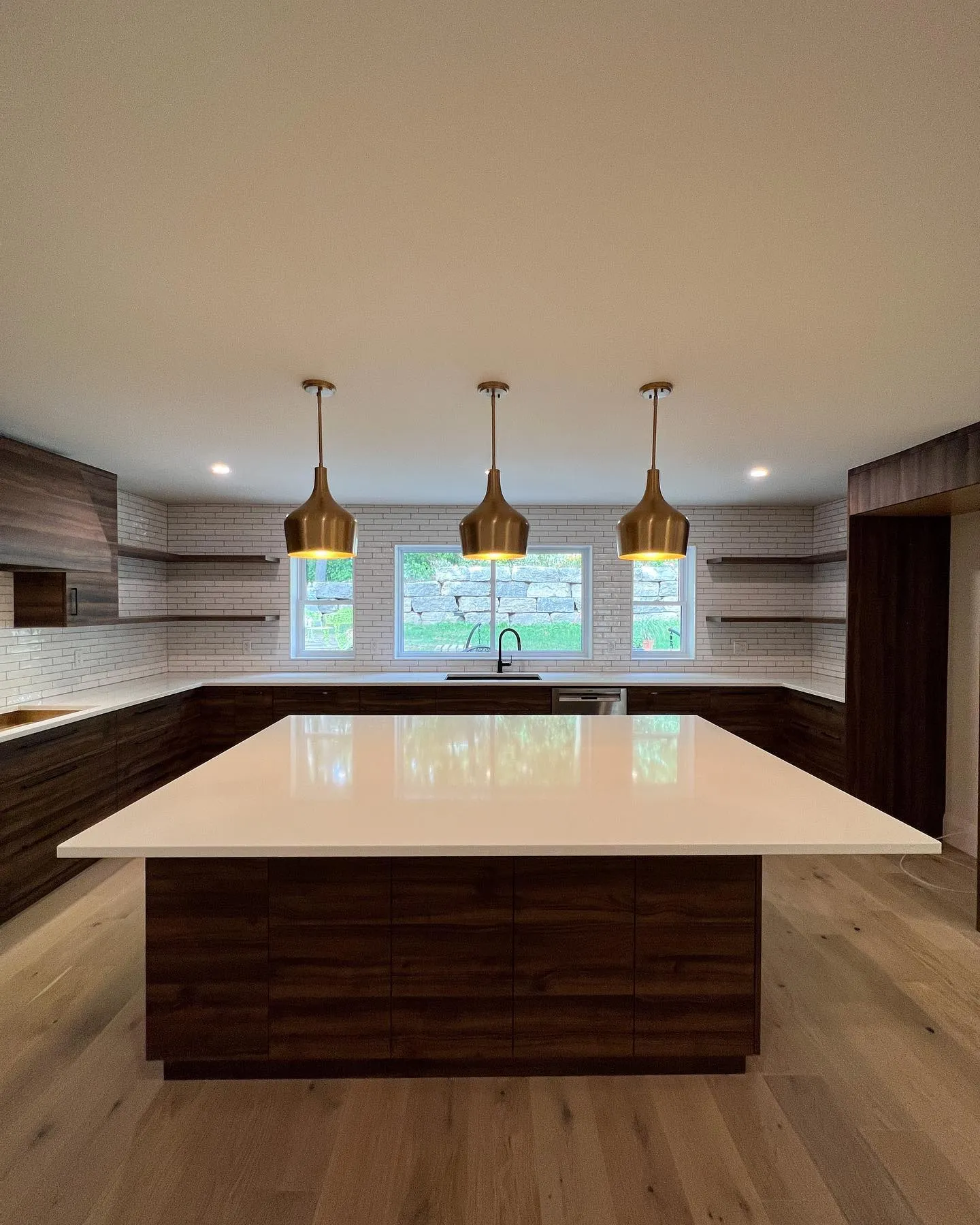
Quick Answer: Kitchen Renovation Costs in Kitchener-Waterloo (2026)
- Essential refresh: $30,000–$55,000 — new cabinetry and finishes in the existing layout, no plumbing moves.
- Mid-range full renovation: $55,000–$110,000 — semi-custom cabinetry, quartz or stone counters, the most common premium scope in KW.
- Premium / custom: $110,000–$200,000+ — custom millwork, layout reconfiguration, premium appliances.
- Biggest cost drivers: cabinetry, layout changes (moving plumbing or walls), and appliance tier.
- Fixed price: a complete scope agreed before work starts is what keeps the number from moving.
The most common question homeowners ask at the start of a kitchen renovation is also the hardest to answer accurately without knowing more: "How much is this going to cost?"
The honest answer is that kitchen renovation costs span an enormous range — from $25,000 for a cosmetic refresh to $250,000 for a custom-built, fully reconfigured premium kitchen. What you're going to spend is determined by a specific set of decisions, most of which can be identified and quantified before a single cabinet is ordered.
This guide gives you real numbers from completed projects in the Kitchener-Waterloo region, breaks down what actually drives cost, and explains how to budget accurately rather than optimistically.
The Three Tiers of Kitchen Renovation
Most kitchen renovations fall into one of three categories. Understanding which tier your project sits in before you start getting quotes prevents the sticker shock that kills renovation projects before they begin.
- Semi-custom or stock cabinetry in existing layout
- Laminate or entry-level quartz countertops
- Basic tile backsplash or painted finish
- Builder-grade or mid-range appliances
- Flooring replacement (LVP or ceramic tile)
- New faucet and sink
- Paint throughout
- No layout changes, no plumbing relocations
Best for: Dated kitchens that function well but need visual updates. Rental properties, pre-sale refreshes, or homeowners with budget constraints.
- Semi-custom cabinetry with quality hardware
- Quartz or natural stone countertops
- Tile backsplash with detail work
- Mid-to-upper-range appliances
- Under-cabinet lighting
- Hardwood or quality LVP flooring
- Minor layout adjustments (sink or appliance relocation)
- Updated electrical (new circuits for appliances)
- Island addition if space allows
Best for: Most primary residences in the KW region. Strong ROI at resale. Enough quality to last 15–20 years without feeling dated.
- Custom cabinetry from local millwork shop
- Natural stone countertops (granite, quartzite, marble)
- Full layout reconfiguration, possibly structural wall removal
- Premium appliances (Wolf, Sub-Zero, Miele, etc.)
- Custom range hood fabrication
- Pot filler, prep sink, bar sink
- Integrated appliances and cabinetry
- In-floor heating
- Full electrical and plumbing reconfiguration
- Custom millwork details (fluted panels, glass inserts, column features)
Best for: Higher-value homes in established neighbourhoods, design-forward homeowners, heritage homes where quality and detail matter at every scale.
What Actually Drives the Cost
Kitchen renovation costs are not driven equally by all components. Understanding where the money goes lets you make deliberate trade-offs rather than random cuts.
The Hidden Costs Homeowners Miss
Layout Changes Are Expensive
Moving a sink to the island involves relocating drain and supply lines under a concrete slab or through framing — a $4,000–9,000 plumbing cost that doesn't appear in a basic estimate. Moving the stove requires a new gas line or dedicated 240V circuit. These aren't optional surprises; they're predictable costs that should be in your quote from day one. If they're not, ask specifically.
Structural Wall Removal
Opening up a galley kitchen or removing a load-bearing wall to create an open plan typically costs $8,000–20,000 including the structural engineering, beam, posts, patching above and below, and permit. The result can be transformative, but the cost needs to be budgeted explicitly rather than treated as a minor line item.
What's Behind the Walls
Older homes in Kitchener, Cambridge, and Waterloo — particularly pre-1970s stock — often reveal knob-and-tube wiring, cast iron drain lines, inadequate ventilation, and occasionally asbestos in original drywall compound or floor tile adhesive. None of these are your contractor's fault. All of them add cost when discovered. A 10–15% contingency budget is essential, not optional.
Cabinetry Lead Times
Custom cabinetry from a quality millwork shop currently runs 8–12 weeks lead time in the KW region. Semi-custom is 5–8 weeks. If you don't have cabinets ordered before construction starts, your project timeline extends by the lead time. A contractor who starts demo before cabinets are ordered is either planning for a long stall or using a lower-quality source.
"We renovated our kitchen during a pretty uncertain time, and they came in on time and on budget. They were very transparent about costs throughout the process." — Susan F., Kitchen Renovation, Kitchener
Where to Spend and Where to Save
Spend Here
- Cabinet construction quality. Door style is cosmetic — box construction determines how long the cabinets last. Plywood boxes, dovetail drawers, and soft-close hardware add cost but add decades to the life of the kitchen.
- Countertop material. You interact with countertops every day. Quartz over laminate is a significant upgrade in durability, appearance, and resale appeal.
- Skilled tile installation. A beautiful tile pattern installed poorly looks worse than a basic tile installed well. Don't cut labour cost on the backsplash or floor.
- Lighting. Under-cabinet lighting, thoughtful pot light placement, and a quality pendant or two over the island cost relatively little and dramatically improve how the kitchen looks and functions.
Save Here
- Appliance brand premiums. Mid-range appliances from reputable brands perform comparably to luxury appliances for most homeowners. Unless you're a serious cook, the performance gap rarely justifies a 3x price difference.
- Exotic stone countertops. Quartz provides the look of stone with better durability and lower maintenance. Unless you specifically want the natural variation of marble or quartzite, quartz is the smarter choice for most kitchens.
- Complex cabinet door styles. Shaker doors cost less than ornate raised panel profiles and photograph better. Simplicity has both aesthetic and financial advantages.
- Changing the layout. If the existing layout works, keeping plumbing and appliances in their current locations saves $10,000–25,000. A beautiful kitchen with an unchanged footprint beats an awkward kitchen with a dramatic reconfiguration.
Getting an Accurate Quote
A kitchen renovation quote is only as accurate as the information given to the contractor. Before your first meeting, know the following:
- Your kitchen's square footage and approximate cabinet linear footage
- Whether you want to change the layout or keep the existing footprint
- Your appliance intentions — bringing existing, mid-range new, or premium
- Cabinet tier preference — stock, semi-custom, or custom
- Countertop material preference
- Whether the project includes flooring or not
- Whether there's a wall you'd like to remove
A contractor who quotes without knowing any of this is not giving you a quote — they're giving you a number designed to win the job, with change orders to follow.
ROI: Does a Kitchen Renovation Pay Off in KW?
Kitchen renovations consistently rank as one of the highest-ROI renovation categories in Ontario real estate. In the Kitchener-Waterloo market, a well-executed mid-range kitchen renovation typically recovers 60–80% of its cost in increased home value — meaning a $75,000 kitchen adds $45,000–60,000 to resale value in addition to the years of enjoyment in the home. Premium renovations in appropriately valued homes tend to recover a similar percentage.
The critical phrase is "appropriately valued." Over-renovating relative to your neighbourhood — a $200,000 kitchen in a $550,000 house — produces diminishing returns at resale. Match your renovation budget to your home's position in the local market.
Frequently Asked Questions
Kitchen renovation costs in the Kitchener-Waterloo region in 2026 vary by scope and finish level. A basic refresh runs $30,000–$55,000. A mid-range full renovation runs $55,000–$110,000. A premium renovation with custom cabinetry, stone countertops, and high-end appliances runs $110,000–$200,000+. Layout changes, structural modifications, and full mechanical updates push costs toward the higher end of each range.
Cabinetry is typically the single largest cost in a kitchen renovation, representing 30–40% of total project cost. Custom cabinetry from a local millwork shop costs significantly more than semi-custom or stock cabinets but offers better quality and longevity. The second largest cost drivers are countertop material, appliances, and labour — which increases substantially if any layout changes require plumbing or electrical relocations.
A building permit is required in Ontario if you are relocating plumbing, performing electrical panel work, removing a load-bearing wall, or making structural changes. Cosmetic renovations — new cabinets in the same locations, new countertops, new flooring, painting — do not typically require a permit. Your contractor should advise on permit requirements based on your specific scope.
A typical full kitchen renovation in the Kitchener-Waterloo region takes 6 to 12 weeks from demolition to completion. The planning and design phase adds 8–14 weeks before construction begins — custom cabinetry lead times are currently 8–12 weeks. Simple refreshes with stock cabinets can move significantly faster. The kitchen is typically unusable for 4–8 weeks during active construction.
In the Kitchener-Waterloo market, the upgrades with the strongest resale return are quality cabinetry with durable hardware, stone countertops, a functional island if the layout allows, under-cabinet lighting, and a cohesive backsplash. Over-specifying appliances for the neighbourhood yields diminishing returns. Focus on quality in the elements that buyers touch and see most frequently.
Ontario changes the rules. We update the guides.
Get an email when a cost guide or regulation guide on this site is revised — a few times a year, nothing else.
Ready to Budget Your Kitchen Renovation?
Caliber Contracting has delivered kitchen renovations across every price tier in Kitchener, Waterloo, Cambridge, and Cambridge since 2007. We'll give you an honest, detailed quote — not a number designed to win the job. Explore our kitchen renovation services to see how we approach the build.
Start a Conversation