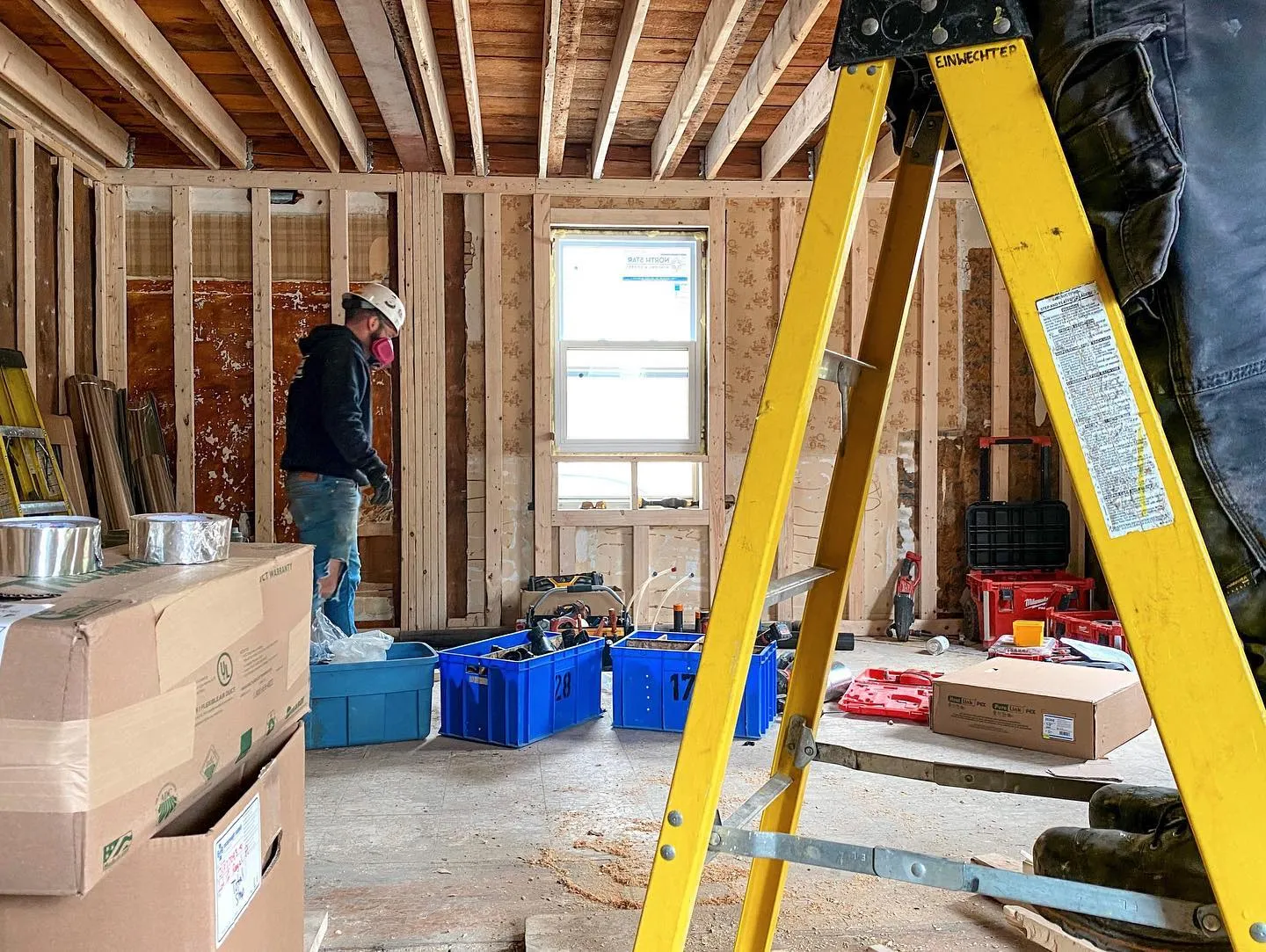
You’re planning a kitchen renovation, a whole-home gut, or an addition. The contractor is going to open your walls. You’re going to see your studs, your wiring, your plumbing — and your insulation, or lack thereof.
This is the moment. The one chance you get to fix the part of your home that determines how comfortable it is, how much you spend on energy, and how long it lasts. And most homeowners miss it because nobody tells them it matters.
What We Find Inside KW-Area Walls
When we open walls in homes across Kitchener, Waterloo, Cambridge, and Paris, here’s what we typically find:
Homes built before 1960: Little to no insulation. Sometimes newspaper. Sometimes sawdust. No vapour barrier, no air barrier. The walls are essentially hollow, and conditioned air moves freely through them.
Homes built 1960–1980: Fibreglass batt insulation, often R-12 in 2x4 walls. Batts are typically compressed, shifted, or installed with gaps. A 6-mil poly vapour barrier may be present but is often torn, unsealed at seams, and punctured by electrical and plumbing work done after original construction.
Homes built 1980–2000: Better batt insulation (R-20 in 2x6 walls), poly vapour barrier, but still no air sealing at penetrations, junctions, or transitions. Air leakage is still significant.
Homes built 2000–2015: Code-compliant insulation and vapour barrier, but air sealing is minimal. Thermal bridging through studs is unaddressed. Performance is adequate but not optimized.
Why the Envelope Is the Highest-ROI Upgrade
During a gut renovation, the incremental cost of upgrading from whatever’s in your walls to a high-performance envelope is surprisingly low because the expensive part — opening and closing the walls — is already happening. You’re paying for demolition and drywall regardless. The additional cost is the insulation and air sealing materials and labour, which typically adds $5,000–$15,000 to a whole-home renovation depending on house size.
That investment delivers:
30–50% reduction in heating and cooling costs. In a 2,000 sq ft home spending $3,500/year on gas and hydro, that’s $1,000–$1,750 saved annually. The envelope upgrade pays for itself in 5–10 years and keeps saving for the life of the home.
Dramatically improved comfort. No more cold spots near exterior walls. No more drafts near windows. Even temperatures throughout the house. This is the difference people notice most — the house just feels different.
Quieter interiors. A well-sealed, well-insulated envelope blocks exterior noise significantly better than a conventional wall. If you live near a busy road, train tracks, or flight path, you’ll notice the difference immediately.
Better indoor air quality. A tight envelope with controlled mechanical ventilation (an HRV) means you decide when and how fresh air enters your home, not the wind. No more dust, pollen, or exhaust fumes being drawn in through random cracks.
What We Do When the Walls Are Open
Step 1: Assess. Before deciding on an insulation strategy, we assess the existing wall assembly, the exterior cladding, and the moisture history. Every home is different, and the right approach for a brick century home in Galt is different from a vinyl-sided split-level in Doon.
Step 2: Air seal. Every penetration gets sealed — electrical boxes, plumbing runs, HVAC ductwork, top plates, bottom plates, rim joists. We use a combination of sealants, gaskets, and purpose-built tapes depending on the application. This step alone can reduce air leakage by 50% or more.
Step 3: Insulate. We select the insulation approach based on the specific wall assembly, moisture management needs, and project goals. There are several excellent insulation materials available — each with different strengths depending on the application. What matters most isn’t the specific product but how it’s integrated into the overall wall system: Is the air barrier continuous? Is the vapour management correct? Are thermal bridges addressed?
Step 4: Verify. On high-performance projects, we can arrange a blower door test after air sealing to quantify the improvement and identify any remaining leakage points before the walls are closed.
The Mistake Most Contractors Make
Most contractors treat insulation as a checkbox: stuff batts in the wall, staple up poly, close the drywall. This approach ignores air sealing entirely, and air sealing is more important than insulation R-value for overall building performance.
Our engineering background means we approach the building envelope as a system, not a line item. We design wall assemblies that manage heat, air, and moisture together — because getting one right while ignoring the others creates problems. A wall that’s well-insulated but poorly air-sealed still leaks energy. A wall that’s tight but has the vapour barrier in the wrong place traps moisture and rots from the inside.
Don’t Miss the Window
Once the drywall goes back up, the opportunity is gone. Retrofitting insulation and air sealing into finished walls is possible but costs 3–5 times more than doing it while the walls are open. If you’re planning a renovation that involves opening walls, talk to your contractor about the building envelope before the project starts — not after.
Frequently Asked Questions
Yes. If the walls are already open, it costs a fraction of doing it as a standalone project. This is your one chance to fix the envelope without tearing into finished walls again.
No air barrier combined with insufficient or poorly installed insulation. Many pre-1980 homes have compressed or gapped fibreglass batts with no air sealing.
Yes, using blown-in cellulose or injection insulation through small holes. But opening the walls during a gut reno and doing it properly is always the better approach.
It can if done incorrectly. Proper vapour management must be designed into the wall assembly. A qualified contractor addresses moisture as part of the insulation strategy, not as an afterthought.
Walls Open? Let’s Talk Envelope.
If your renovation involves opening walls, you have a once-in-a-generation chance to upgrade your building envelope. Caliber Contracting can help you make the most of it.
Start a Conversation