Ten years ago, recommending a heat pump in Ontario was a fast way to lose a client’s confidence. The technology of that era genuinely couldn’t handle our winters — capacity dropped by half before the temperature got past -10°C, and the “auxiliary heat” light on the thermostat was on for half of January. Homeowners who installed them anyway often pulled them out within a few years.
That’s not the conversation anymore. We specify cold-climate heat pumps as the default heating system in nearly every renovation, addition, and ADU project we build in Kitchener, Waterloo, and Cambridge. Most of our clients add a small electric backup as insurance — and most of them never see it run. The technology in 2026 is fundamentally different from the technology of 2015, and the gap between perception and reality is now wide enough that it’s worth a clear explanation of what changed and what it means for your project.
What Actually Changed
Three things shifted in the last decade. None of them is marketing.
Inverter-driven compressors replaced fixed-speed compressors. A traditional heat pump compressor was either fully on or fully off. To deliver more heat, it cycled on and off rapidly. As outdoor temperatures dropped, those cycles got harder and shorter, and efficiency collapsed. Modern inverter compressors run continuously at variable speeds — they can spin faster when more heat is needed, and they can extract heat from outdoor air much more aggressively when the temperature drops. This is the single most important change.
New refrigerants extract heat at lower temperatures. Older systems used R-22 and then R-410A, both of which lose effectiveness in the cold. The current generation uses R-32 and R-454B, which have a much wider operating range and can still pull usable heat from outdoor air well below -25°C. By 2026, these are standard in every cold-climate-rated unit.
Variable-speed fans and improved defrost cycles mean the system can run efficiently across a much wider range of conditions and shed ice from the outdoor coil without dumping cold air into the house — a common complaint with older units.
The result, in plain numbers: a properly specified cold-climate heat pump in 2026 maintains 100% of its rated heating capacity at -15°C and continues producing usable heat down to -25°C or -30°C, depending on the model. A decade ago, most systems were down to 30-40% capacity at -10°C. That’s a transformation, not an improvement.
How They Actually Perform in a Kitchener-Waterloo Winter
Our region’s winters are well within the comfort zone of modern cold-climate heat pumps. Most KW winters bottom out around -22°C to -25°C for a few nights. Average January lows sit closer to -10°C to -12°C. For 90-95% of the heating season, a good cold-climate unit handles the entire load with significant efficiency advantages over a gas furnace.
The honest counterpoint: in late January 2026, Ottawa hit -37.8°C. At those temperatures, every air-source heat pump on the market drops to roughly the same efficiency as an electric resistance heater. KW didn’t get that cold — we bottomed out around -28°C — but it’s worth knowing that the deep-freeze edge case exists. That’s why we include backup heat in every install, and why the question of what kind of backup matters.
Backup Heat: Why We Recommend Electric, Not Gas
Most HVAC contractors in Ontario will tell you that you need a gas furnace as backup for the heat pump, set up as a “hybrid” or “dual-fuel” system. There’s a reasonable case for that approach in some homes — particularly older homes with poor insulation or homes already running gas for cooking, hot water, and a fireplace.
For new construction, additions, ADUs, and most of our whole-home renovations, we specify electric backup instead. A few reasons:
The backup runs rarely. In a properly insulated home with a correctly sized cold-climate heat pump, the backup heat element kicks in only during the coldest week or two of the year — and often not even then. Most of our clients with electric backup tell us it never runs.
You eliminate the gas connection. No furnace means no gas line into the mechanical room, no gas meter, no annual furnace inspection, no carbon monoxide concerns from combustion appliances. For ADUs and detached garden suites in particular, skipping the gas service connection saves real money on the install.
The cost difference for the rare backup hours is small. Electric resistance heat is more expensive per unit of energy than gas, but if it’s only running a handful of hours per year, that cost difference is rounding error. The simplicity is worth it.
We do still recommend hybrid systems for some homes — typically older, leakier houses where the gas furnace is relatively new and the renovation scope doesn’t include a full envelope upgrade. In that case, keeping the furnace and adding a heat pump for the milder 80% of the year is the smart move. Every project is different, and we make the call on the specific home.
Why This Matters for Renovation Projects
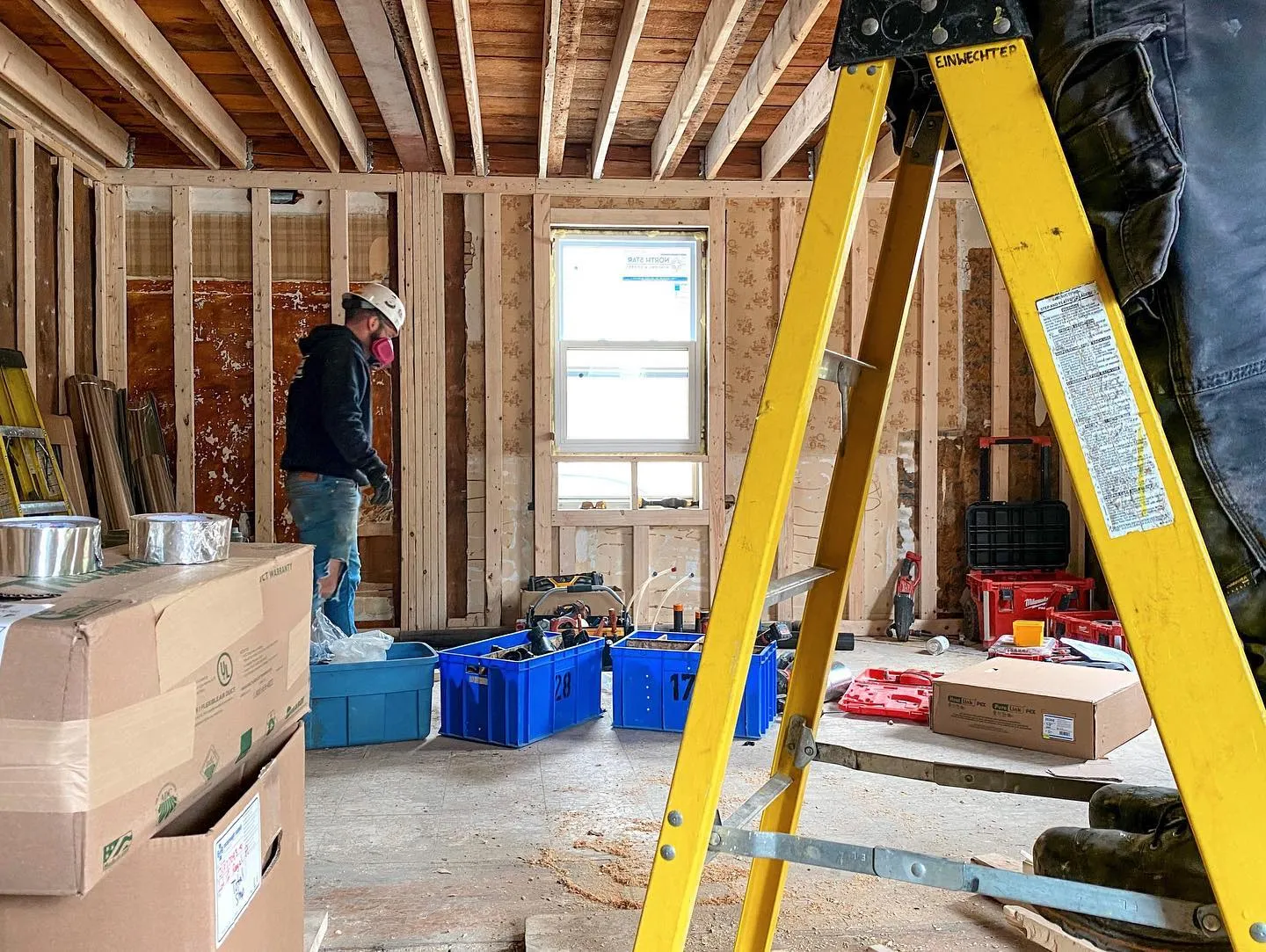
Heat pump retrofits to existing homes are common and worthwhile, but they’re more expensive and more disruptive than they need to be when done as a one-off project. The economics change dramatically when a heat pump is integrated into a renovation, addition, or new build from day one.
During a whole-home renovation, the walls are already open. Running new electrical, upsizing the panel if needed, and routing ductwork or refrigerant lines for a ducted or ductless heat pump is straightforward when nothing is finished yet. Adding the same system to a finished home means cutting drywall, fishing wires, and patching afterward.
During an addition, the heating load calculation has to be redone anyway. Designing the system around a heat pump from the start means proper sizing, proper duct design, and no awkward retrofits to the existing furnace later.
For ADUs and garden suites, ductless mini-split heat pumps are nearly perfect. They’re compact, they don’t require ductwork, they handle both heating and cooling in one system, they’re quiet, and they slot into a 400-800 sq ft unit cleanly. We use them in nearly every detached ADU we build.
For custom home builds, integrating a heat pump from the design phase lets us right-size everything: insulation, windows, electrical service, mechanical room. The result is a home that hits its energy targets without overbuilding any single component.
The Envelope Comes First
The single most important thing to understand about heat pumps: they amplify whatever building envelope you give them. A drafty, poorly insulated house with a brand-new heat pump is still a drafty, poorly insulated house. The heat pump runs constantly, the backup heat kicks in often, and the homeowner concludes that “heat pumps don’t work.”
Heat pumps work — but they work best in homes with good air sealing, continuous insulation, and quality windows. The order of operations matters:
- Air seal the building envelope first
- Insulate to current code or better — focus on continuous insulation and minimizing thermal bridging
- Upgrade windows where they’re failing
- Then size the heat pump to the new heating load, not the load before envelope upgrades
This sequence matters because Ontario’s Home Renovation Savings Program actually requires it for the bundled rebate path — you have to complete an envelope upgrade alongside the heat pump to access the maximum incentive. It’s also genuine engineering advice that we’d give regardless of rebates.
Every Caliber project starts with envelope evaluation, not equipment selection. We don’t spec a heat pump until we know what heating load the renovated home will actually carry. This sequence is the difference between a heat pump that runs efficiently for 15 years and one that struggles from day one.
What's Available in 2026: Rebates and Incentives
The rebate landscape changed significantly when the federal Greener Homes Grant closed and Ontario’s Home Renovation Savings Program took over in January 2025. As of April 2026:
- Cold-climate air-source heat pump: up to $7,500 through Home Renovation Savings (rate varies by heating fuel — gas-heated homes get less per ton than electrically-heated homes)
- Ground-source (geothermal) heat pump: up to $12,000
- Bundled upgrades (insulation + heat pump + air sealing, etc.): higher combined totals, but require pre- and post-retrofit energy assessments
- Canada Greener Homes Loan: still active in 2026, offering up to $40,000 interest-free over 10 years for qualifying upgrades including heat pumps
- Oil-to-Heat-Pump Affordability Program (OHPA): for homes currently heating with oil, up to $15,000 in additional support
The most common rebate-killer is doing work in the wrong order. If you’re going for the bundled path, no work can start before the pre-retrofit energy assessment is completed. Skip that step and the rebate disappears, even if everything else is done correctly. We coordinate the assessment timing as part of the renovation schedule for any project where the rebates are in play.
How We Size and Specify Heat Pumps
A few principles that drive how we approach this on a Caliber project:
Don’t oversize. This is the most common mistake — installing a heat pump that’s too big for the actual heating load. An oversized unit short-cycles in milder weather, runs inefficiently, and fails to dehumidify properly in summer. We do a Manual J load calculation for every project, not a back-of-envelope estimate.
Specify a cold-climate-rated unit. Not every unit on the rebate-eligible list is genuinely cold-climate-rated. Look for units rated to maintain 100% capacity at -15°C and to operate down to -25°C minimum. Mitsubishi Zuba, Daikin Aurora, Bosch IDS, Carrier Greenspeed, and a few others meet that bar.
Match the indoor and outdoor units. Mismatched systems lose efficiency, void warranties, and disqualify rebates. AHRI certification matters.
Plan the backup correctly. A properly sized electric backup is typically 5-10 kW depending on the home. Larger backup elements may require an electrical service upgrade to 200 amps. We assess this during design, not after install.
When a Heat Pump Isn't the Right Call
Honesty matters. Heat pumps aren’t always the answer:
- Very old homes with deeply compromised envelopes where the renovation scope doesn’t include envelope work — a high-efficiency gas furnace may be the right call, and a heat pump can come later when the envelope is improved
- Homes on propane in rural areas with limited electrical service — the math gets complicated; sometimes the cost to upgrade the electrical service kills the project
- Very small, very intermittently heated spaces — cottages, garages, workshops — where simpler resistance heating may be more economical
- Clients with strong personal preferences for the feel of forced-air gas heat — a heat pump produces less hot but more constant air, and some people genuinely prefer the warmer, more cyclical feel of a gas furnace
We have no ideological commitment to heat pumps. We specify them often because the engineering and economics work for the homes we build. When they don’t, we say so.
Where This Fits in a Caliber Project
If you’re already planning a renovation, addition, ADU, or custom home build, the heat pump conversation is part of the project from day one — not a separate decision tacked on at the end. Integrating it during design is dramatically cheaper and yields better results than retrofitting afterward.
If you’re considering a heat pump as a standalone retrofit project, that’s also work we do, but the highest-leverage time to make this decision is when other work is happening on your home anyway.
Frequently Asked Questions
Yes. Modern cold-climate heat pumps maintain full heating capacity to -15°C and continue producing usable heat to -25°C or -30°C. KW winters typically bottom out around -22°C to -25°C, well within the operating range of properly specified equipment.
Usually no. We specify electric backup in most installs, and most of our clients tell us it rarely runs. Hybrid (gas backup) systems make sense for some older, leakier homes where the existing furnace is relatively new — we make the call on the specific project.
In the Kitchener-Waterloo region, a quality cold-climate air-source heat pump installed in an existing home typically runs $12,000 to $20,000 before rebates. Geothermal systems run $25,000 to $40,000+ depending on ground loop type. Costs are lower when integrated into a larger renovation because some of the work — electrical, framing access, ductwork — is already happening.
Up to $7,500 for cold-climate air-source heat pumps and up to $12,000 for ground-source through Ontario’s Home Renovation Savings Program. The Canada Greener Homes Loan (up to $40,000 interest-free) is still active. Oil-to-heat-pump conversions can access additional support through OHPA.
Most modern homes on 200-amp service can accommodate a heat pump without issue. Older homes on 100-amp service sometimes need an upgrade, particularly if the backup heat element is large. We assess this during design.
Modern systems are designed for 12-15 years of reliable service, similar to a high-efficiency furnace. Variable-speed compressors and quality installation extend that range.
Indoor air handlers are typically quieter than gas furnaces because the variable-speed fan rarely runs at full speed. The outdoor unit produces some noise — comparable to a central air conditioner — which matters for placement, especially near bedrooms or in tight side yards. We design placement carefully during renovation projects to keep noise away from sleeping and outdoor living areas.
Yes. Heat pumps are essentially reversible air conditioners — they provide both heating and cooling in one system. If you’re replacing both a furnace and an air conditioner, switching to a heat pump means one piece of equipment instead of two, with one set of refrigerant lines and one outdoor unit. This integration saves space and reduces maintenance complexity.
Related Reading
Ready to Plan a Renovation?
Caliber Contracting designs and builds renovations, additions, custom homes, and ADUs across Kitchener, Waterloo, Cambridge, and Paris — with heat pumps specified as the default heating system in nearly every project.
Start a Conversation